Lesson 5 - Family & friends basics (+ mini pronunciation podcast)
Lesson 5 - Family & friends basics (+ mini pronunciation podcast)
French in 30: Communicate in daily life, even if you're not confident.
Module 0 - The French appetizer: Start speaking French today, step by step
Module 0 - The French appetizer: Start speaking French today, step by step
Module 1 - Talk first, perfect later
Module 1 - Talk first, perfect later
Module 2 - Talk without freezing
Module 2 - Talk without freezing
Module 3 - Build Solid Grammar Basics
Module 3 - Build Solid Grammar Basics
Module 4 - Say It, Sound Right
Module 4 - Say It, Sound Right
Module 5 - [LOCKED: Complete Modules 1-4 to Unlock]
Module 5 - [LOCKED: Complete Modules 1-4 to Unlock]
Le Grand Exam
Le Grand Exam
Talking about family and friends helps you introduce yourself better and connect with people.
1. Family words
-
la famille /LAFAMIY/ (without L) → family
-
la mère (maman) /LAMERR/ → mother
-
le père (papa) /LEPERR/ → father
-
la grand-mère (mamie) /LAGRANMERR/ → grand mother
-
le grand-père (papy) /LEUGRANPERR/ → grand father
-
le frère /LEFRERR/ → brother
-
la sœur /LASEUR/ → sister
-
le fils /LEFISS/ → son
-
la fille /LAFIY/ (again, without L) → daughter
le petit-fils /LEPTIFISS/ → grand son
la petite-fille / LAPTITT-FIY/ → grand daughter
l'oncle (tonton) /LONCL/ → oncle
la tante (tata) /LATANTT/ → aunt
-
les parents /LéPARAN/ (final T silent)→ parents
-
les grands-parents /LéGRANPARAN/ → grandparents
-
les enfants /LéZANFAN/ → children
le cousin /LECOOZ-1/ → male cousin
la cousine /LACOOZINNN/ → female cousin
le neveu /LEUNEUVEU/ → nephew
la nièce /LANIESS/ → niece
Family tree - L'arbre généalogique
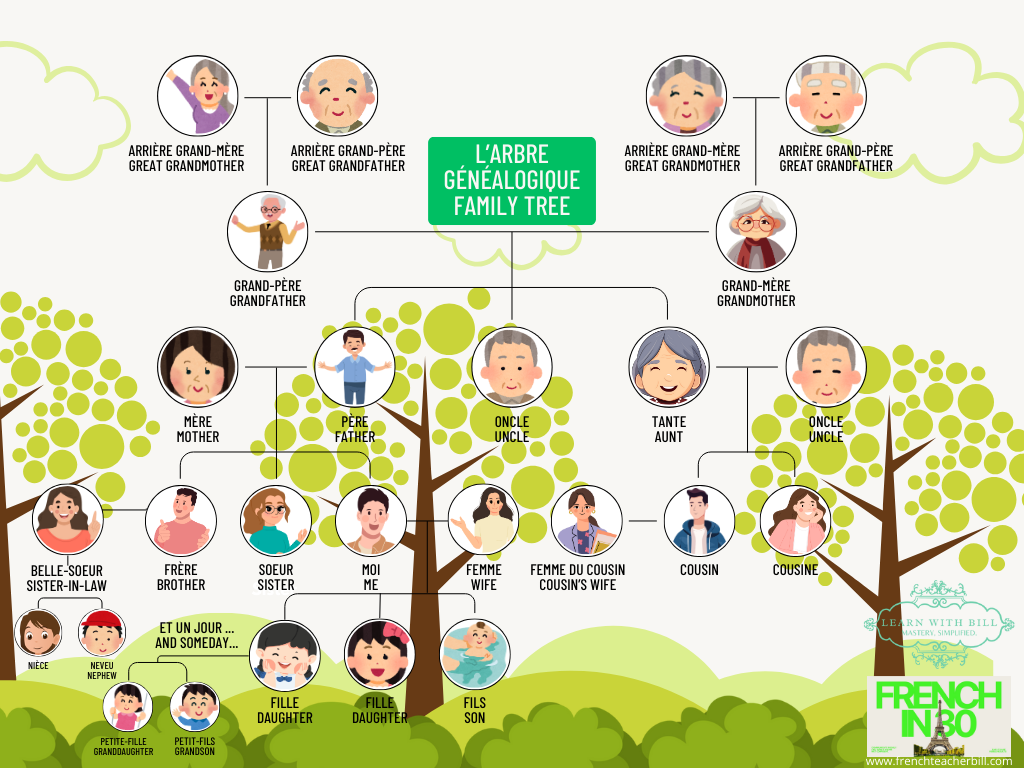
Bonus: Use this link to make your own "arbre généalogique" in French, with pictures: https://www.canva.com/design/DAGxZh6TXrY/NAwNIVkM1agC07ZddKJmSg/view?utm_content=DAGxZh6TXrY&utm_campaign=designshare&utm_medium=link&utm_source=publishsharelink&mode=preview
Others:
le beau-frère /LEBOFRERR/ → brother-in-law
le demi-frère /LEDEMIFRERR/ → half-brother
la demi-sœur /LADEMISEURR/ → half-sister
la belle-mère /LABELMERR/ → mother-in-law
le beau-père /LEBOPERR/ → father-in-law
le beau-fils /LEBOFISS/ → son-in-law
la belle-fille /LABELFIY/ → daughter-in-law
l'arrière-grand-mère /LARIERR-GRAN-MERR/ → great-grandmother
l'arrière-grand-père /LARRIERR-GRAN-PERR/ → great-grandfather
-
la belle-famille /LABELFAMIY/ → family-in-law
How to ask about brothers and sisters?
-
T’as combien de frères et sœurs ? →How many brothers and sisters do you have? (informal)
T’as /TA/ → you have
Combien /CONBI-1/ → how many (or how much)
de /2/ or /DEU/ → of (literally)
frères et sœurs /FRERRéSSEUR/ no need to make the liaison /FRERRZéSSEUR/ (even though it’s correct.) → brothers and sisters
Vous avez combien de frères et sœurs ? (Formal)
Vous avez /VOOZAVé/ → you haveHow many brothers and sisters do you have?
T’as /TA/ → you have
Combien /CONBI-1/ → how many (or how much)
de /2/ /DEU/ → of (literally)
frères et sœurs /FRERRéSSEUR/ no need to make the liaison /FRERRZéSSEUR/ (even though it’s correct.) → brothers and sisters
-
Vous avez combien de frères et sœurs ? (Formal)
Vous avez /VOOZAVé/ → you have
And then you reply:
-
J’ai une sœur et deux frères. → I have one sister and two brothers.
-
Je suis fils unique /FISSUNIC/ → I’m an only child (masc)
fille unique /FIYUNIC/ (fem):
-
Mes parents habitent à New York. /MéPARAN/ and /ABITT/ → My parents live in New York.
2. Friends & relations
ma femme /MAFAM/ → wife
mon mari /MON-MARI/ → husband
mon ami / mon amie → a friend
mon meilleur ami / ma meilleure amie /MON or MA-MEYEURAMI//→ my best friend (masc / fem)
un copain / une copine /1COP-1/ /UNNCOPINN/→ a buddy (informal masc / fem)
mon fiancé / ma fiancée
mon petit ami / ma petite amie → boyfriend / girlfriend (but it's not often used), prefer:
mon copain / ma copine → my boyfriend / my girlfriend
👉 Example
-
Voilà mon ami Marc. → This is my friend Marc.
-
C'est ma copine. → She’s my girlfriend. (Don't say "elle est ma copine", use "c'est")
-
Elle est française → She's French. (Now you can use "elle est" because you're describing)
3. Talking about yourself and others
Useful starter phrases:
J’ai … → I have …
Il a … / Elle a … → He has / She has …
Nous sommes … → We are … (a little bit formal) prefer:
On est ... → We are ... (more usual and common than "nous")
-
How to pronounce them:
👉 Examples
J’ai deux enfants. → I have two kids.
Elle a trois sœurs. → She has three sisters.
On est cinq dans ma famille. → There are five of us in my family.
-
How to pronounce them:
4. Practice questions
-
T'as des frères et sœurs ? → Do you have brothers and sisters?
-
Il a une copine ? → Does he have a girlfriend?
-
Vous êtes combien dans ta famille ? → How many people are in your family?
Mini dialogue
— T'as une grande famille ?
— Oui, j’ai deux frères et une sœur.
— Et tes parents ?
— Ils habitent aux États-Unis.
👉 After this lesson, you can:
Introduce your family.
Talk about friends or relationships.
Ask others about theirs.
Beaucoup d'informations. Bon, on fait une pause café ... à la prochaine leçon !